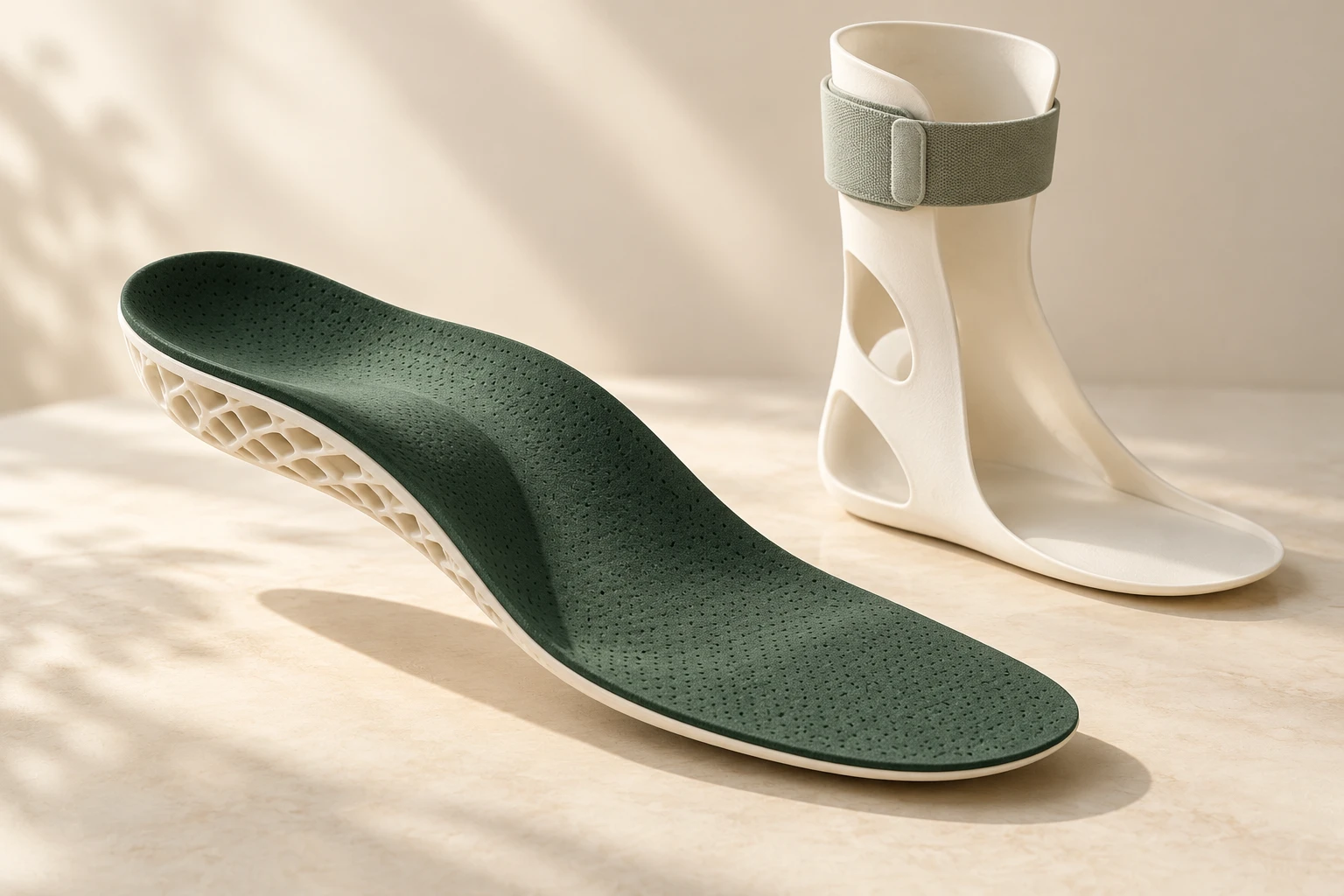
Your brand.better fit. Custom orthotics manufacturing,
From a product specification to a new concept, connect digital design, development and manufacturing through MB MedTech.
YOUR VISION. YOUR IDENTITY. One MB MedTech contact.
01 / FORM MEETS POSSIBILITY Made for the individual.
Concept visualization · final products follow approved specifications DEVELOPED WITH YOUR BUSINESS IN MIND Brands & distributors ✳ O&P laboratories ✳ Clinical networks ✳ Product innovators
WHY DIGITAL ORTHOTICS & PROSTHETICS?
Capture the shape. Digital tools can reduce reliance on physical casts and connect capture, design and fabrication.
Non-contact capture Digitize external body shape without a plaster impression where suitable.
Individual geometry Use captured contours as a starting point for personalized design.
Reusable digital records Retain approved files for review, revisions and repeat work.
Connected handoffs Transfer compatible scan data into CAD/CAM and production planning.
Production efficiency Evaluate opportunities to reduce manual steps, rework and material waste.
Project-specific value Compare equipment, labor, materials and review costs against your current process. 01 / WHAT WOULD YOU LIKE TO CREATE?
Start with the people Explore a product direction. We’ll help define the development scope, inputs and manufacturing requirements.
02 Limb orthoses ↗ 03 Spinal & specialty orthoses ↗ 04 Prosthetic projects ↗
FOOT & FOOTWEAR A foundation for your product line. Explore custom foot orthoses, performance insoles and footwear interfaces developed around fit, materials and your intended market.
DEFINE TOGETHER Intended use, arch geometry, material layers, size range and branding.
BRING TO THE BRIEF A reference sample or design, your customer profile and estimated order volume.
Build an insole project brief ↗ Product directions are subject to feasibility review. Clinical design, testing and market requirements are agreed for each project.
ORTHOTICS & PROSTHETICS / APPLICATION EXPLORER
More possibilities. Explore the application that fits your next OEM or ODM brief. Select a category, then tell us what you want to develop.
Orthotics 06 Prosthetics 06
01 Cranial remolding orthoses Head-shape data for custom helmet development.
Project considerations + Discuss the specialist-led design process, scan method, shell and lining choices, adjustment needs and required product documentation.
Discuss this application ↗ 02 Upper-limb orthoses Arm and hand geometry for personalized orthoses.
Project considerations + Specify the anatomical area, intended support, fastening system, materials and clinical design responsibilities.
Discuss this application ↗ 03 AFO / KAFO Lower-limb shapes for ankle-foot and knee-ankle-foot orthoses.
Project considerations + Outline the intended user, coverage, articulation or rigidity, footwear interface and testing requirements.
Discuss this application ↗ 04 Spinal & scoliosis braces Torso capture for individually shaped bracing concepts.
Project considerations + Discuss the clinical design, anatomical coverage, adjustment system, ventilation and fitting process.
Discuss this application ↗ 05 Foot orthoses & insoles Foot geometry translated into customized insole designs.
Project considerations + Bring your target customer, shoe type, size range, material preferences and branding requirements.
Discuss this application ↗ 06 Chest orthoses Chest contours for pectus orthosis development.
Project considerations + Define the specialist partner, intended use, contact surfaces, adjustment method and validation responsibilities.
Discuss this application ↗ 07 Prosthetic sockets Residual-limb geometry for an individualized socket interface.
Project considerations + Specify the socket type, connection requirements, liner interface, clinical team and sample approval process.
Discuss this application ↗ 08 Upper-limb prostheses Anatomical inputs for hand and arm prosthetic projects.
Project considerations + Clarify whether the brief covers a socket, cosmetic component or broader assembly, and identify the functional components involved.
Discuss this application ↗ 09 Lower-limb prostheses Limb data for socket and prosthetic development.
Project considerations + Identify the proposed component scope, mechanical interfaces, intended activity level and professional fitting responsibilities.
Discuss this application ↗ 10 Ear prostheses Ear geometry for personalized external prosthetic forms.
Project considerations + Discuss reference anatomy, appearance, materials, attachment approach and the specialist fabrication partner.
Discuss this application ↗ 11 Breast prostheses Contour data for individually shaped external forms.
Project considerations + Define the external product concept, contour, material feel, finish and intended market requirements.
Discuss this application ↗ 12 Facial prostheses Facial shape capture for customized prosthetic contours.
Project considerations + Review the anatomical region, appearance requirements, attachment, material selection and specialist involvement.
Discuss this application ↗ Applications are development possibilities, subject to partner capability and feasibility. Clinical assessment, prescription where required, validation and fitting remain with appropriately qualified professionals.
02 / CHOOSE YOUR STARTING POINT
One ambition. A brand ready for a product. A specification ready for production. An idea ready for development.
A / BRAND-LED ↗
Private label Explore eligible product platforms with your identity, approved customization and market positioning.
Product and option selection Branding and packaging scope Sample and commercial review Start with your brand ↗ B / SPECIFICATION-LED ↗
OEM Bring your design or technical specification. Define a manufacturing route around agreed requirements.
Drawings and specification review Materials and process assessment Samples and acceptance criteria Start with your specification ↗ C / CONCEPT-LED ↗
ODM Turn a market need into a development brief, with clear responsibilities from concept to launch.
Concept and feasibility review Prototype development scope Design ownership and release plan Start with your idea ↗ Minimum order quantities apply. Product availability, customization rights, development fees and order terms are confirmed in your proposal.
DIGITAL INPUT. INDIVIDUAL FORM.
From a scanwith purpose. 3D scanning captures body geometry for digital design. Approved designs can then move into suitable additive or CNC fabrication workflows.
Discuss scan inputs, software compatibility and production requirements as part of your project—not as separate decisions.
Explore a digital workflow ↗ THE DIGITAL PRODUCT JOURNEY MB / 03
01 Capture Shape & scan inputs
↓ 02 Design Geometry & material intent
↓ 03 Develop Prototype & fabrication
Build around your product—not a single equipment brand.
BUILD YOUR DIGITAL WORKFLOW
The right tools. Scope the capture, design and manufacturing tools around your application. Equipment and integration options are reviewed with the selected partners.
01 / CAPTURE Portable 3D scanning Discuss handheld or all-in-one scanning, real-time capture feedback and body-area settings for your intended application.
Review: scan area, positioning, working environment and operator training. 02 / FOOT WORKFLOWS Dedicated foot capture Explore foot-scanning platforms and positioning accessories for insole and orthotic-footwear development.
Review: capture method, fit objectives and downstream design requirements. 03 / DIGITAL DESIGN O&P software Evaluate guided scanning, mesh processing, anatomical scan modes and compatible STL or OBJ export on selected systems.
Review: file compatibility, editing tools, licenses and record handling. 04 / INTEGRATION Software connections Explore SDK access where available to connect scan capture with your own design or manufacturing workflow.
Review: access rights, development scope, data protection and ongoing support. Your workflow, defined together. Confirm the exact hardware, software, file formats, integration rights and branding scope in your proposal.
Discuss workflow integration ↗ FROM DATA TO DEVELOPMENT
Three application journeys. Illustrative production pathways to help shape your brief. The final method follows your approved design and project requirements.
FOOT ORTHOSES From impression Capture Scan foot geometry or a suitable foam impression.Prepare Clean and align the mesh; review incomplete areas.Design Build the insole outline and surfaces around the design brief.Develop Prepare an approved model for prototyping and fabrication.Plan an insole workflow ↗ CRANIAL ORTHOSES From head shape Capture Obtain a surface model using an appropriate scanning method.Design Develop the helmet geometry with a specialist clinical team.Prototype Assess a suitable fabrication route, including additive manufacturing where appropriate.Review Agree the clinical, material, fitting and release checks.Plan a cranial project ↗ PROSTHETIC SOCKETS From limb data Capture Record residual-limb shape and relevant surface markings.Modify Apply specialist design adjustments in the selected software.Fabricate Evaluate an approved in-house or manufacturing-partner route.Review Define fit assessment, component interfaces and acceptance criteria.Plan a socket workflow ↗ 03 / THE DEVELOPMENT PROCESS
Clarity at every step. A practical path from an initial conversation to an agreed manufacturing plan.
01 Define Set the user, intended use, target market, volumes and project goals.
02 Digitize Review scans, samples, drawings, file formats and required geometry.
03 Develop Assess materials, design options, prototypes and fabrication routes.
04 Validate Agree sample approval, testing, labeling and release responsibilities.
05 Prepare Confirm packaging, order terms, traceability and the production plan.
BEFORE YOU BEGIN
Good questions. Can the product carry my own brand?+ Private labeling and customization are reviewed for the selected product and manufacturing partner. Branding rights, packaging and labeling responsibilities are confirmed before production.
Do I need a finished design or scan file?+ No. OEM starts with a defined specification; ODM can start with a concept. Begin with a business description, intended use and estimated volume. The team will arrange the appropriate channel for technical files.
What are the minimum order quantities and lead times?+ Minimum quantities, sampling costs and timelines depend on the product, materials, tooling and development work. Share your planned initial order and expected annual volume for a project-specific proposal.
Who owns the design and handles validation?+ Design ownership, tooling rights, validation, quality criteria and release responsibilities are defined in the project agreement. Requirements depend on the intended product and sales market.
Can scanning hardware or software be included?+ Scanning and workflow integration can be discussed as a separate scope. Hardware branding, software access, file compatibility and integration rights require confirmation with the selected technology partner.
04 / LET’S MAKE IT YOURS
What would you Your next product starts
Tell us what you know today. MB MedTech will review your business requirements and discuss the next step.
Sales@MBMedTechUSA.com ↗ HELPFUL STARTING DETAILS Intended use · target market · order volume